

Enterprise — studios, networks, streamers and global brands with a security review
Built for the security review.
An organisation whose identity, security and procurement teams decide before unreleased footage moves — a studio or network’s vendor programme, a streamer’s production partners, a global brand’s marketing operations.
Your setup
The spaces you run, and what each one is for in a company like yours.
Crew
Every studio in the group, each isolated
Client
Your partners and business units
The Suite
One library per studio
Who you invite, and exactly what they see
Access is decided by the database, person by person — nobody sees more than their part.
Everyone, through your identity provider
What SCIM provisions; deactivation signs them out everywhere at once
People across several studios
Each studio separately, switching between them
Your security team
The permission ledger — every grant, denial and assignment
What changes for you
Identity, enforced
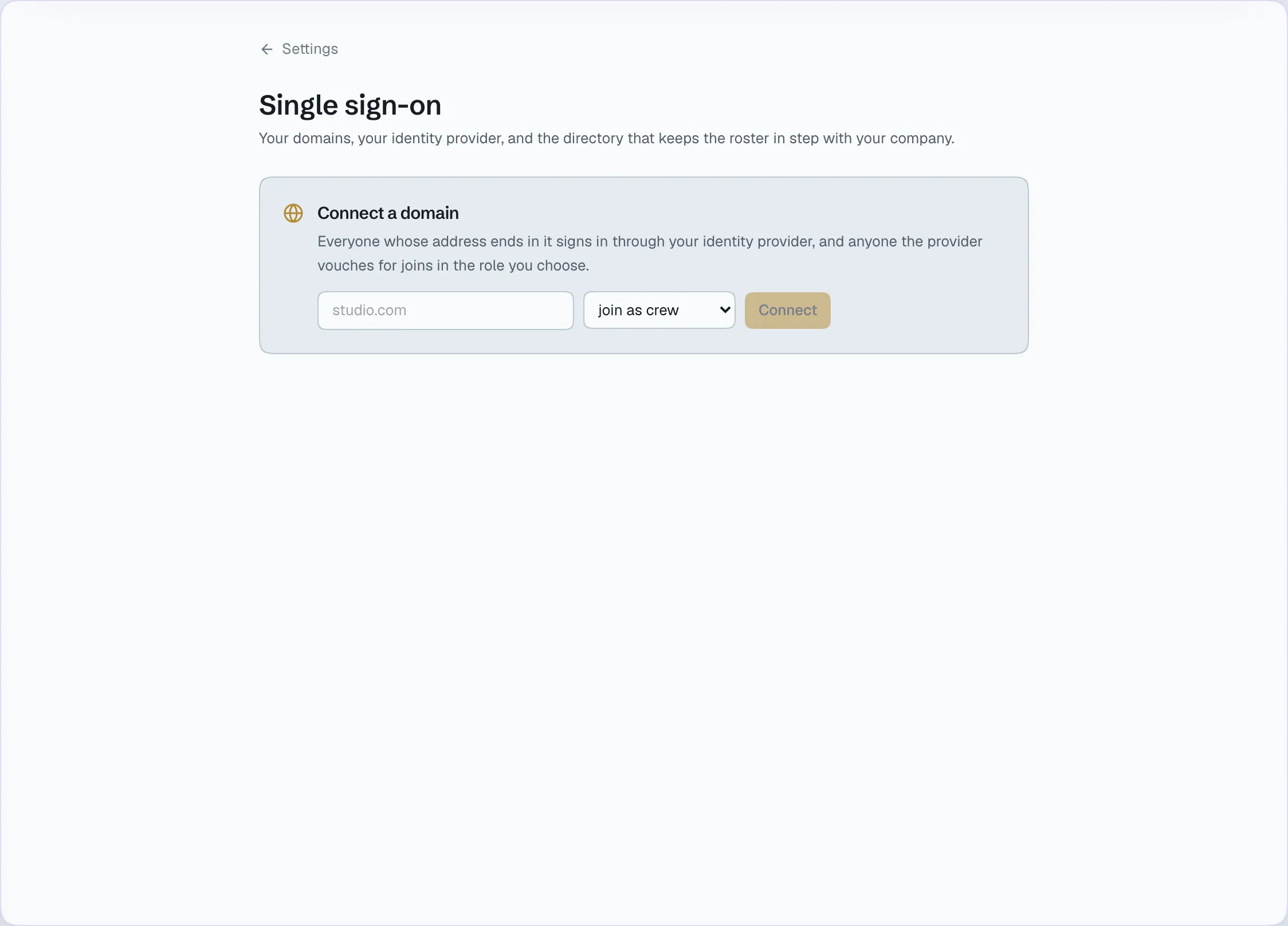
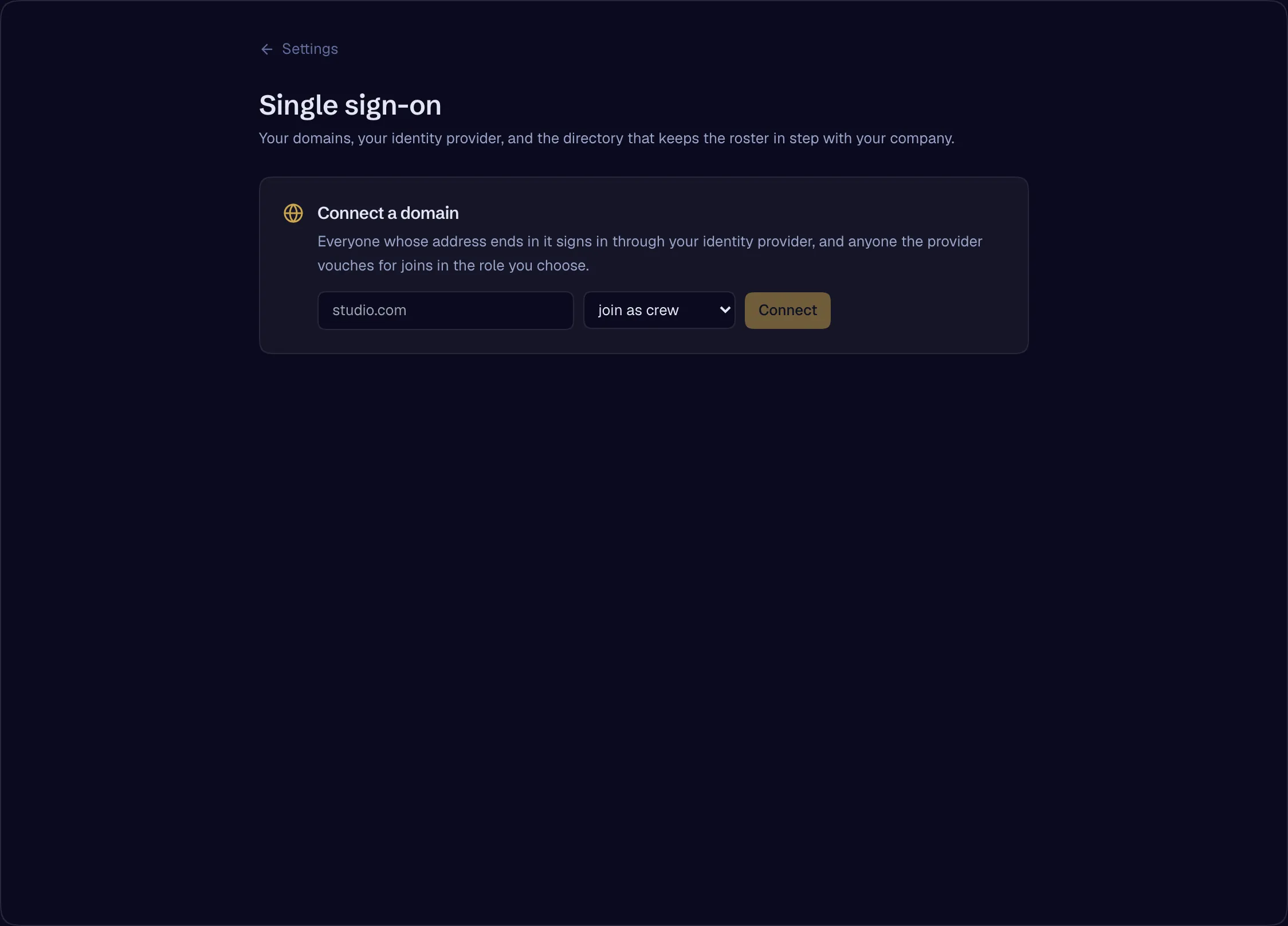
SAML or OIDC on a domain proved by DNS, enforcement, just-in-time provisioning and SCIM 2.0.
- Single sign-on — SAML and OIDC, domain proof, enforcement, just-in-time provisioning
Your own rules
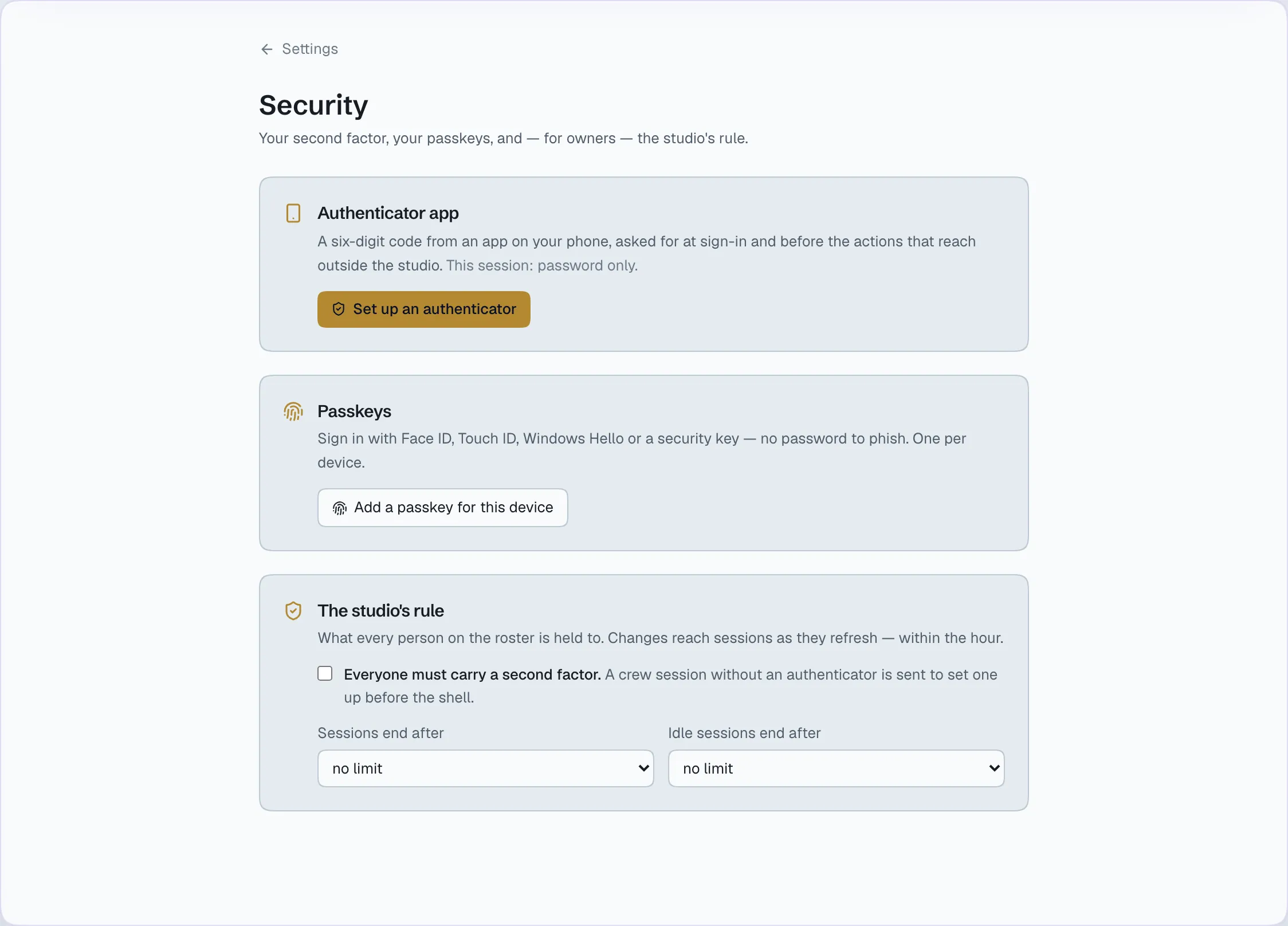
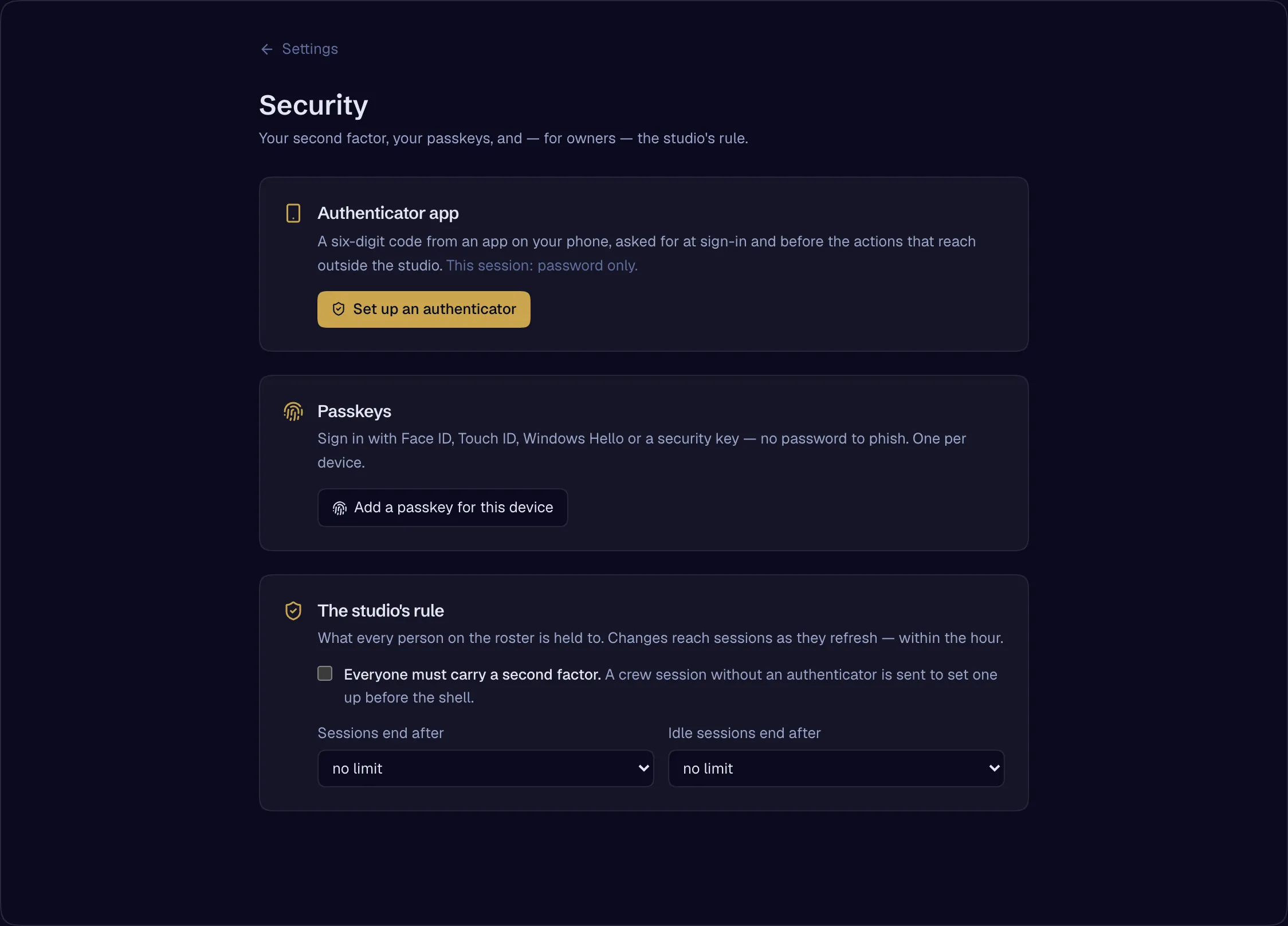
Required two-factor, a maximum session age and an idle timeout, set by you.
- A studio’s own security rules — two-factor required, session limits
Isolation you can verify
Studio isolation enforced in the database and proven by 128 automated security checks.
- Studio isolation — the database is the tenancy boundary, proven by 100 automated checks
No certification is held yet — no SOC 2, no ISO 27001, no TPN assessment. The security page lists every gap beside its plan. The roadmap
Identity
Single sign-on with SAML or OIDC: the domain is proved by a DNS record first, then the provider is connected, and enforcement refuses a password to anybody on the domain. People the provider vouches for are provisioned just in time; SCIM 2.0 creates, updates and removes them — and removal signs them out everywhere at once.
- Single sign-on — SAML and OIDC, domain proof, enforcement, just-in-time provisioning
- SCIM 2.0 provisioning
Your rules
Require two-factor for the whole studio, and set how long a session may last and how long it may sit idle. Sensitive actions ask for the second factor again.
- A studio’s own security rules — two-factor required, session limits
- Two-factor sign-in, recovery codes, step-up for sensitive actions
- Passkeys
Permissions and the ledger
Company roles, project roles, staff and contractor seats, and individual grants and denials with expiry, resolved from the roster on every request — never from a token. Delegation limits are database rules. Every change is written to the permission ledger.
- Company roles — owner, admin, producer, coordinator, finance, crewAvailable
- Project roles with capability baselinesAvailable
- Seat class — staff and contractor; a contractor sees nothing until assignedAvailable
- Individual grants, denials and expiry; a denial beats a grantAvailable
- Delegation limits enforced as database triggers
- Permission ledgerAvailable
Several organizations, one person
A person can belong to more than one studio and switch between them; each studio sees only its own.
- Membership in several organizations, with switchingAvailable
Isolation, retention and erasure
Studio isolation is enforced in the database and proven by 128 automated security checks. Deleted rows wait out a grace window before they are purged; the activity ledger is kept for seven years; a person can be erased with a stable pseudonym left in their place. Everything is hosted in one US region.
- Studio isolation — the database is the tenancy boundary, proven by 100 automated checks
- Retention — soft delete, a grace-window purge, seven-year ledger retention
- Person erasure with a stable pseudonym
- One US region, stated plainly
For procurement
Genreline holds no certification yet, and says so: the security page lists what has not been done, and the roadmap carries the plan for each. Talk to us about your questionnaire, your identity provider and what your content-security team needs to see.
Talk to us
Open a studio, invite your team, add your first client. The record starts with the first approval.